Dark/Light Mode
BREAKINGNEWS
- Manggala Agni Kemenhut Tetap Padamkan Karhutla di Tengah Berbagai Kendala
- Pertamina Patra Niaga Dorong Pendidikan Masyarakat Pesisir Lewat Sekolah Alam
- Gempa Darat M4,0 Guncang Pasaman Sumatera Barat, Kedalaman 16 Km
- Pertamina Gandeng UMKM Lombok Jual Merchandise Resmi di MotoGP 2026
- Kemenperin Dorong Kawasan Industri Jadi PSN Untuk Percepat Hilirisasi
PROFISH: Breathing New Energy into Coastal Pindang Fish Processing
Minggu, 13 Juli 2025 19:24 WIB

1. Introduction
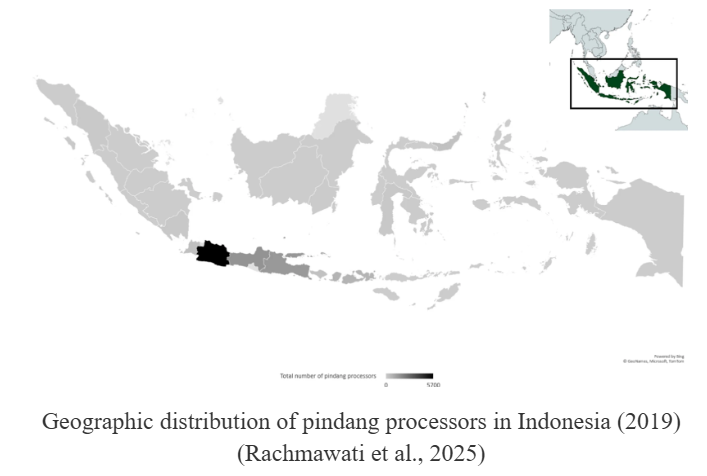
Indonesia is one of the largest fish producers in the world with its fishing industry contributing over USD 25 billion to its GDP and employing more than 7 million Indonesians. With an annual output of over 21 million tons, the industry, particularly its small-scale fisheries, plays a vital role in ensuring food security and sustaining livelihoods across Indonesia's extensive coastal regions. With a variety of methods in Indonesia’s fish processing, the traditional Pindang fish processing method is widely practiced by coastal Micro, Small, and Medium Enterprises (MSMEs) as a crucial component of local economies and food preservation. It is a process of boiling the fish in salted water, and then being left to dry. Indonesian pindang processors are distributed across the country, with total numbers of more than 10,000 in 2019; of these, approximately 5000 were located in West Java (Rachmawati et al., 2025).
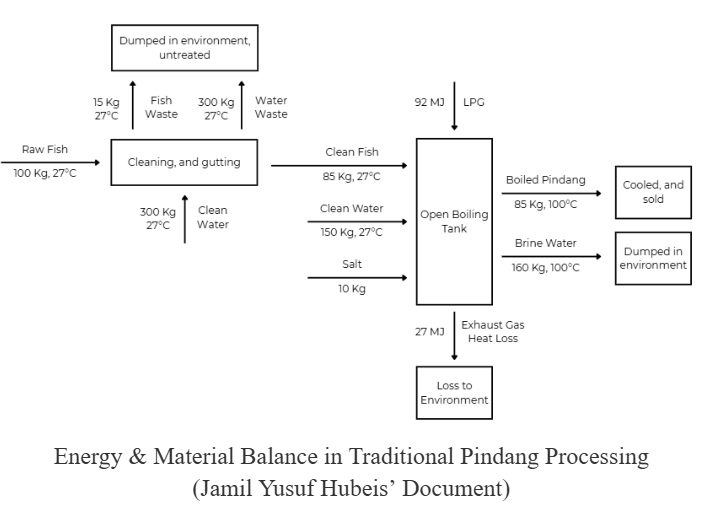
Indonesia’s small-scale Pindang processors face environmental and economic inefficiencies. Open boiling vats cause heat loss and high fuel consumption, increasing costs for MSMEs. Untreated organic wastewater and solid fish waste are discharged to the environment, causing marine pollution, odors, and greenhouse gas emissions. These issues are a challenge against Indonesia's sustainability, SDG progress, and blue economy resilience, undermining the national Blue Economy roadmap.
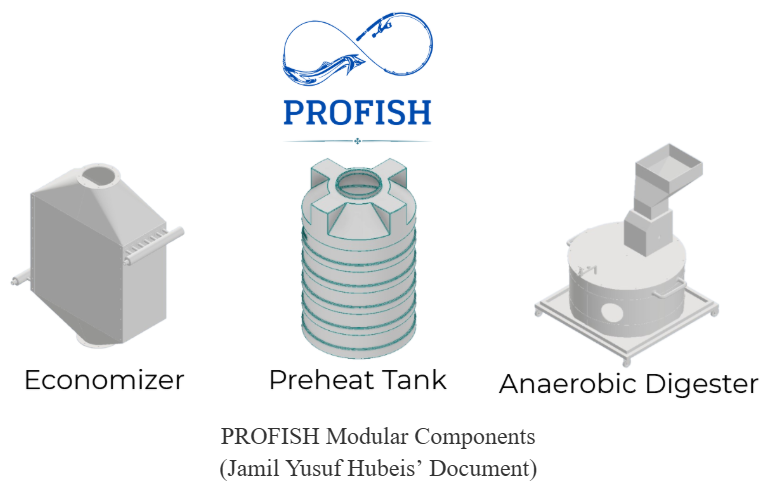
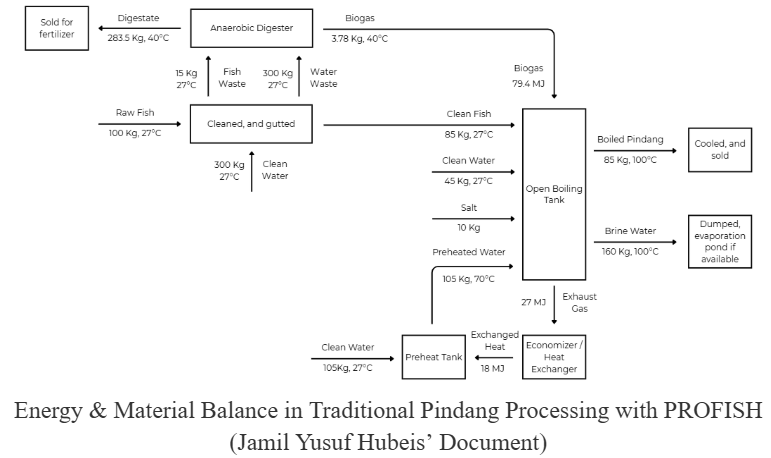
This is where PROFISH (Processing for Fisheries Sustainability & Hygiene) comes in. A concept that aims to revolutionize Pindang fish processing with a modular, low-cost system for sustainability and efficiency. It recovers waste heat from boiling to preheat water, improving energy efficiency and reducing external fuel reliance. Organic waste from cleaning and gutting is converted into biogas via an anaerobic digester, which then fuels the boiling tank, cutting LPG use. PROFISH aims to empower coastal MSMEs with integrated sustainable technologies, which leads to better resource efficiency, lower environmental impact, and enhanced economic viability.
2. Methodology
This study applies a conceptual engineering design approach to develop an integrated heat and waste recovery system for small-scale Pindang fish processing, comprising boiling, heat recovery, anaerobic digestion, and water preheating. Mass and energy flows were estimated from empirical, literature, and thermodynamic data. Biogas yields were projected using a mesophilic anaerobic digestion model. A finned-tube economizer was modeled to recover ~70% of exhaust heat.
Energy recovery and fuel savings were simulated under the assumptions of a stable state of operations. Daily biogas production and heat recovery potential were converted into equivalent fuel savings and matched against typical LPG use in MSME fish boiling. Financial analysis included capital expenditures (CAPEX), operating costs (OPEX), and savings over a 10-year period. Key metrics calculated include Net Present Value (NPV), Internal Rate of Return (IRR), and payback period, using a 12% discount rate suitable for MSME-level investment risk in Indonesia. Performance was benchmarked against traditional processes lacking heat reuse and waste recovery.
3. Result and Discussion
This section presents the outcomes of the conceptual design and analysis of the PROFISH system. The results are structured into four key focus areas: Energy Efficiency through Heat Recovery, Biogas Production Capacity, Reduction in Organic Discharge, and Financial Feasibility. Each component highlights the system’s potential to improve sustainability and resource efficiency in small-scale pindang fish processing.
Energy Efficiency through Heat Recovery
PROFISH includes the integration of a finned-tube economizer. Calculations based on a boiling tank that requires approximately 92 MJ of thermal energy per cycle show that the exhaust gas retains around 27 MJ of usable thermal energy. With an assumed heat recovery efficiency of 70%, the economizer is able to preheat approximately 105 kg of water from ambient (27 °C) to 70 °C, translating to a recovered energy of 18.9 MJ per cycle. This preheated water is then reused in cleaning and boiling processes, reducing energy needs by 20% per cycle. The incorporation of this exchanger not only cuts fuel costs but also reduces total thermal losses, lowering the carbon intensity of traditional fish boiling operations.
Biogas Production Capacity
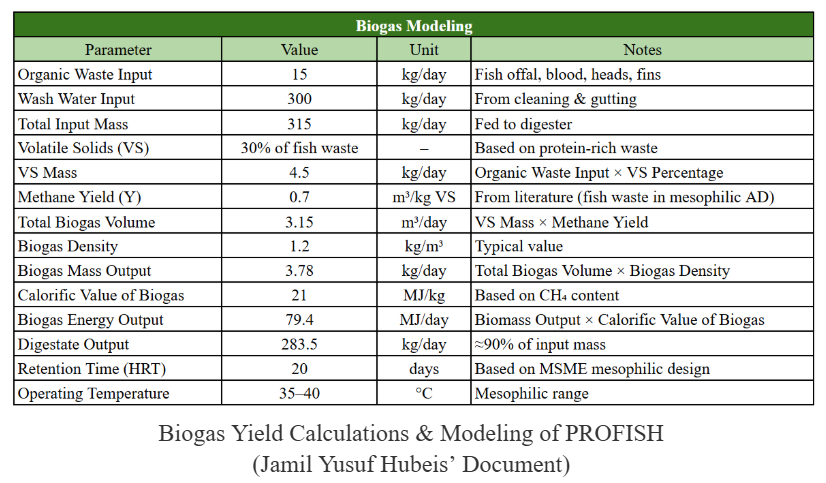
In fish processing, 10–20% of fish mass is removed as waste, this represents a significant source of organic energy potential. After modeling anaerobic digestion with assumptions in the table below, PROFISH is projected to produce 3.15 m³ of biogas per day, equivalent to approximately 3.78 kg at standard conditions. Given a typical biogas calorific value of 21 MJ/kg, the digester would generate 79 MJ of thermal energy daily, which is more than enough to meet the remaining energy needs of the boiling process. After an initial retention period of roughly 20 days, the system achieves a steady biogas production, enabling partial or even complete substitution of LPG in continuous operations.
Reduction in Organic Discharge
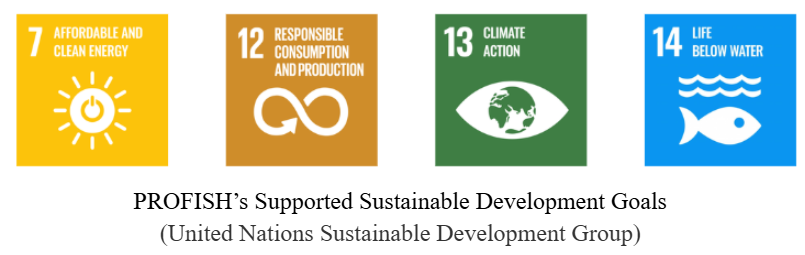
Traditional Pindang processing typically discharges wastewater with a high organic content directly into open drains or nearby soil. This leads to local pollution, foul odor, and potential pathogen spread. By diverting both solid and liquid organic waste into an anaerobic digester, PROFISH eliminates up to 90% of untreated organic discharge. The post-digestion digestate (roughly 283.5 kg/day) is biologically stabilized and can be used as a fertilizer substitute, thus creating a circular waste loop. The system supports SDGs 7, 12, 13, and 14 by promoting circular resource use, reducing marine pollution, and cutting GHG emissions.
Financial Feasibility
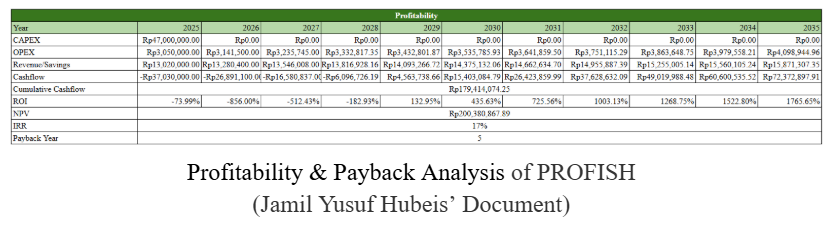
To ensure feasibility of PROFISH to MSMEs across Indonesia, a plausible financial assessment is necessary to show potential economic gains for the fisheries & business owners. Financial projections, extending to 2035, only account for revenue generated from energy savings and waste value. This analysis includes detailed projections of annual cash flows, return on investment (ROI), and cumulative cash flow. Using 12% as the discount rate, the NPV over a 10-year period is projected at Rp200,380,867.89 and an IRR of 17%, indicating a highly positive return on investment. capital expectations in Indonesia. Importantly, the system achieves a full payback period within 5 years, which is ideal for small businesses. This can be further supported by CSR programs, local governments, and MSME grants supported by The table below summarizes the key financial indicators under the optimized operational scenario.
4. Conclusion
The PROFISH system offers a modular, low-cost solution to enhance sustainability in small-scale pindang fish processing. Through waste heat recovery and anaerobic digestion, the system significantly reduces LPG use, recycles organic waste into biogas and fertilizer, and minimizes environmental damage. Calculations show that PROFISH can generate enough biogas to fully substitute fuel needs while recovering up to 20% of thermal energy from exhaust gases. This combination of heat and waste recovery, and economic returns provides a viable path toward circular, low-emission fishery practices. With an NPV of Rp 200.3 million, IRR of 17%, and a payback period of 5 years, PROFISH proves to be both technically and financially suitable for adoption by coastal MSMEs all across Indonesia. PROFISH offers a replicable, scalable model for low-impact, high-efficiency traditional Pindang processing in Indonesia’s coastal regions, aligning technological innovation with national sustainability goals.

Jamil Yusuf Hubeis
Jamil Yusuf Hubeis - Universitas Indonesia
Jamil Yusuf Hubeis - Universitas Indonesia
Update berita dan artikel RM.ID menarik lainnya di Google News
Dapatkan juga update berita pilihan dan breaking news setiap hari dari RM.id. Mari bergabung di Grup Telegram "Rakyat Merdeka News Update", caranya klik link https://t.me/officialrakyatmerdeka kemudian join. Anda harus install aplikasi Telegram terlebih dulu di ponsel.
Tags :
Berita Lainnya