Dark/Light Mode
BREAKINGNEWS
- Zaskia Adya Mecca, Turun Langsung Padamkan Karhutla
- Chelsea Vs Tottenham Hotspur, Derby Sarat Kepentingan
- Moto3 Australia, Veda Ogah Ngotot Di Phillip Island
- KBRI Paris Minta WNI Waspadai Demo Lanjutan di Prancis: Perhatikan Jam Malam
- Polda Metro Ciduk Dua Tersangka Pengiriman 26 Jeriken Merkuri Ke Burkina Faso
FORESIGHT-ID: Forecasting of GHG Emissions Across 21 Province in Indonesia
Minggu, 13 Juli 2025 19:14 WIB

Indonesia’s rising greenhouse gas (GHG) emissions present an increasingly critical issue, with national carbon dioxide emissions reaching 674.5 million tonnes CO₂e in 2023, over sixteen times greater than five decades ago (World Bank, 2024). The industrial sector contributes approximately 34% of emissions, followed closely by energy production dominated by fossil fuel-based power generation (World Bank, 2024). This escalating emission trend starkly contrasts with Indonesia's ambitious vision, Indonesia Emas 2045, which aims to reduce GHG emission intensity by 93.5% from the 2010 baseline (Bappenas, 2022).
Literature reviews identify four primary systemic issues hindering effective GHG emission management in Indonesia. Firstly, there is inadequate monitoring and transparency in emission data at both national and regional levels. Currently, there is no national mandate requiring industries or regional governments to regularly report their GHG emissions. Existing inventory data tend to be aggregated, macro-scale, and not real-time, thus inadequate for spatial or temporal detection of emission spikes (IESR, 2023; Al Rasyid, 2023).
Secondly, carbon emission regulations are inefficient and stagnant. Despite the enactment of Undang-Undang Harmonisasi Peraturan Perpajakan (UU HPP), which includes a carbon tax instrument, its implementation has been repeatedly postponed until 2025. Even if enacted, the proposed carbon price of Rp30–270 per kg CO₂e is considered too low compared to the economic valuation of climate damages (Al Rasyid, 2023; Santoso, 2022). Thirdly, structural interventions and collaborations between the government and industry remain limited. The absence of a deliberative approach in setting national residual carbon emission standards results in low policy adoption rates and technical resistance to carbon incentives (Santoso, 2022).
Fourthly, and critically, there is a lack of comprehensive studies on spatial GHG emission mapping and analyses of multidimensional contributing factors. Most available reports are sectoral or macro-based, lacking integration with variables such as industrial GDP growth, production value, the number of large-medium industries, and socio-economic characteristics of regions in correlation with actual emissions. Consequently, policymakers lack precise spatial and sectoral information to design contextually appropriate, targeted, and measurable regulations.
To address these challenges, this study introduces FORESIGHT-ID, a predictive and regulatory platform leveraging machine learning designed to map, classify, monitor, and project GHG emissions across 21 Indonesian provinces from 2000—2045. FORESIGHT-ID comprises four main pillars, which are depicted in Figure 1, to tackle the root causes of Indonesia’s rising GHG emissions and achieve Indonesia’s 2045 carbon-neutral targets.
Baca juga : LOTTE Mart Korea Komit Promosikan Bisnis Berkelanjutan di Indonesia
Indonesia’s rising greenhouse gas (GHG) emissions present an increasingly critical issue, with national carbon dioxide emissions reaching 674.5 million tonnes CO₂e in 2023, over sixteen times greater than five decades ago (World Bank, 2024). The industrial sector contributes approximately 34% of emissions, followed closely by energy production dominated by fossil fuel-based power generation (World Bank, 2024). This escalating emission trend starkly contrasts with Indonesia's ambitious vision, Indonesia Emas 2045, which aims to reduce GHG emission intensity by 93.5% from the 2010 baseline (Bappenas, 2022).
Literature reviews identify four primary systemic issues hindering effective GHG emission management in Indonesia. Firstly, there is inadequate monitoring and transparency in emission data at both national and regional levels. Currently, there is no national mandate requiring industries or regional governments to regularly report their GHG emissions. Existing inventory data tend to be aggregated, macro-scale, and not real-time, thus inadequate for spatial or temporal detection of emission spikes (IESR, 2023; Al Rasyid, 2023).
Secondly, carbon emission regulations are inefficient and stagnant. Despite the enactment of Undang-Undang Harmonisasi Peraturan Perpajakan (UU HPP), which includes a carbon tax instrument, its implementation has been repeatedly postponed until 2025. Even if enacted, the proposed carbon price of Rp30–270 per kg CO₂e is considered too low compared to the economic valuation of climate damages (Al Rasyid, 2023; Santoso, 2022). Thirdly, structural interventions and collaborations between the government and industry remain limited. The absence of a deliberative approach in setting national residual carbon emission standards results in low policy adoption rates and technical resistance to carbon incentives (Santoso, 2022).
Fourthly, and critically, there is a lack of comprehensive studies on spatial GHG emission mapping and analyses of multidimensional contributing factors. Most available reports are sectoral or macro-based, lacking integration with variables such as industrial GDP growth, production value, the number of large-medium industries, and socio-economic characteristics of regions in correlation with actual emissions. Consequently, policymakers lack precise spatial and sectoral information to design contextually appropriate, targeted, and measurable regulations.
To address these challenges, this study introduces FORESIGHT-ID, a predictive and regulatory platform leveraging machine learning designed to map, classify, monitor, and project GHG emissions across 21 Indonesian provinces from 2000—2045. FORESIGHT-ID comprises four main pillars, which are depicted in Figure 1, to tackle the root causes of Indonesia’s rising GHG emissions and achieve Indonesia’s 2045 carbon-neutral targets.
Baca juga : Dorong Kemandirian Energi Nasional, PHE Pacu Produksi Gas di Indonesia Timur
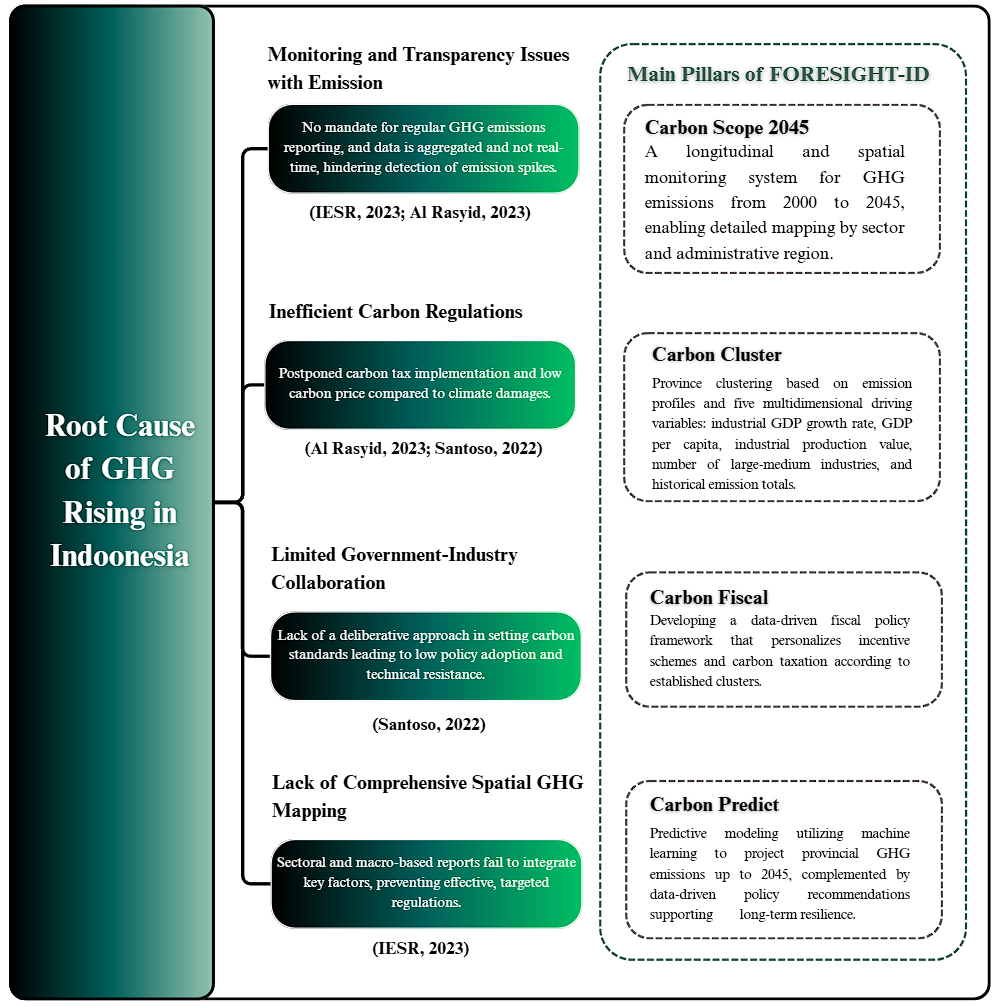
Figure 1 Main Pillars of FORESIGHT-ID
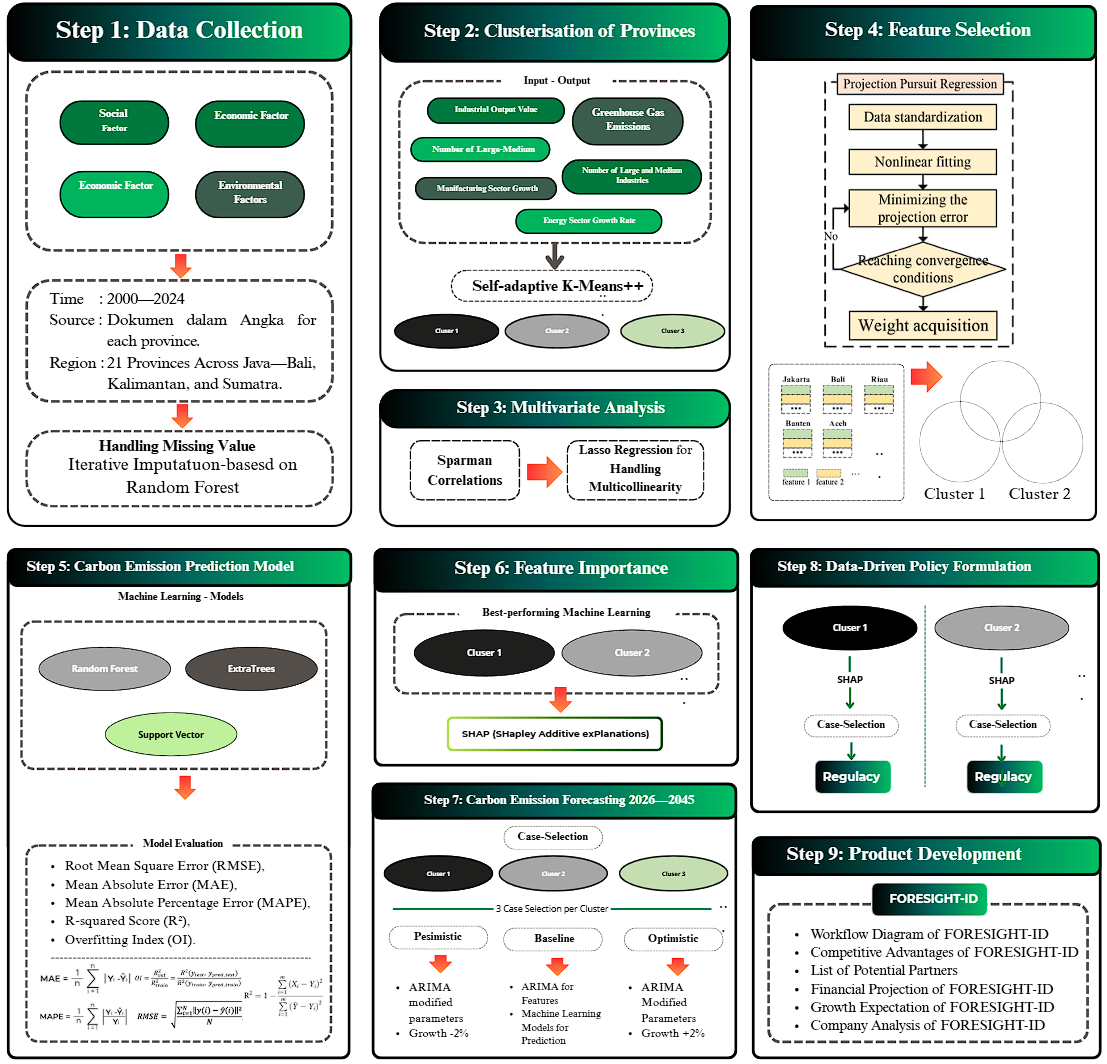
Figure 1.1 Algorithm structure diagram
In Figure 1.1, this study is divided into 9 workflow processes. The dataset obtained from the "Provinsi dalam Angka" publication undergoes interpolation for each province across the 17 factors, excluding the GHG variable as the target, to fill in the missing data. An adaptive K-means++ algorithm is used to cluster provinces into distinct groups based on six key driving factors. Spearman's correlation is employed to detect multicollinearity among the driving factors, which is then addressed using Lasso regression. To predict carbon emissions, three machine learning models are used. The model with the highest accuracy is selected through five parametric statistical evaluation models. The best-performing model is then further analyzed using SHAP (Shapley Additive Explanations) to interpret the contribution of individual features to the model's predictions. Case selection will be performed per cluster, with three categories: pessimistic, baseline, and optimistic. Finally, we introduce FORESIGHT-ID as the platform used to analyse prediction results and provide policy recommendations for each category.
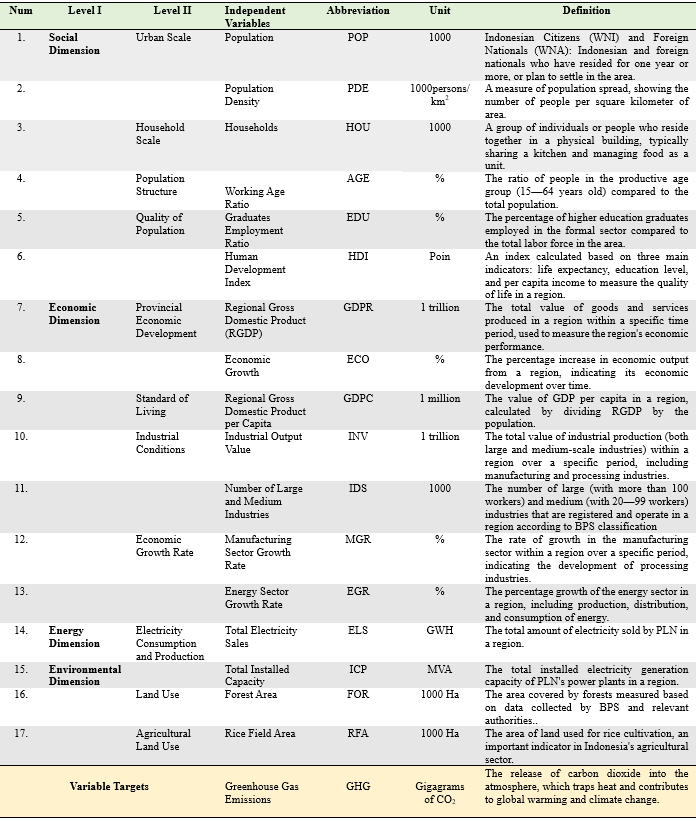 Table 2.1 Dataset Description and Multidimensional Factors
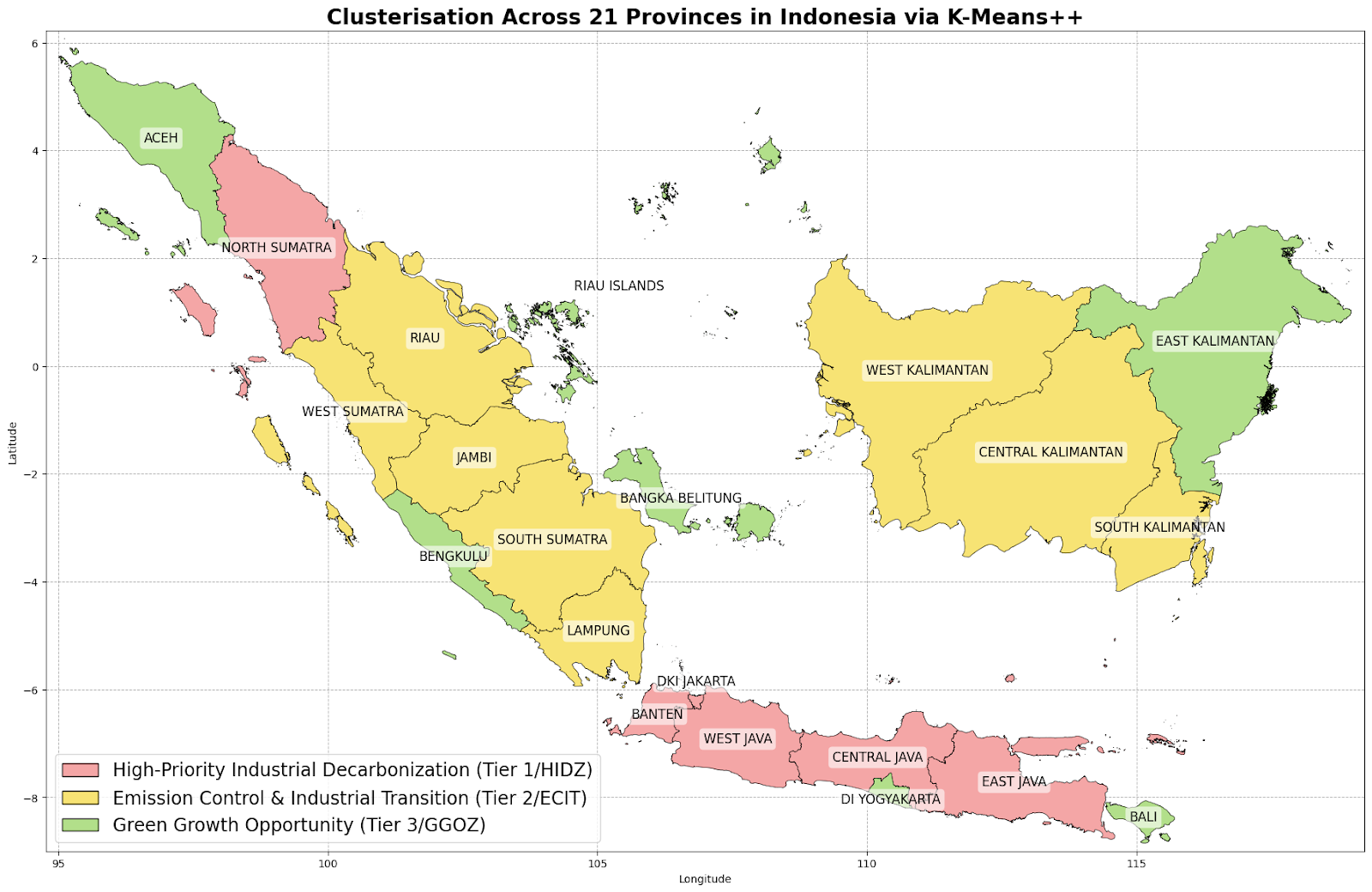
Figure 3.2 Clusterisation Across 21 Provinces
The classification of provinces into clusters using K-means++ is essential for understanding how socio-economic factors influence greenhouse gas (GHG) emissions across Indonesia. Provinces are grouped based on historical economic and industrial data from 2000-2024, using six key driving factors that are weighted to assess industrial output and socio-economic characteristics. These clusters are: High-Priority Industrial Decarbonization (HIDZ): Includes provinces like DKI Jakarta and East Java, which have high levels of industrial activity and emissions. Emission Control & Industrial Transition (ECIT): Includes provinces like Riau and West Kalimantan, where the economy is transitioning, and emissions are moderately high. Green Growth Opportunity (GGOZ): Includes regions like Aceh and DI Yogyakarta, where industrial activity is less intensive, allowing for potential green growth strategies.
Baca juga : Ketua MPR Apresiasi Komitmen Prabowo Di Dunia Pendidikan Indonesia
 Table 3.1 Industrial-Economic Factor Values per Province Cluster

Bondan Attoriq
Institut Teknologi Bandung
Institut Teknologi Bandung
Update berita dan artikel RM.ID menarik lainnya di Google News
Dapatkan juga update berita pilihan dan breaking news setiap hari dari RM.id. Mari bergabung di Grup Telegram "Rakyat Merdeka News Update", caranya klik link https://t.me/officialrakyatmerdeka kemudian join. Anda harus install aplikasi Telegram terlebih dulu di ponsel.
Tags :
Berita Lainnya