Dark/Light Mode
BREAKINGNEWS
- Sabtu Berkah Bareng Ojol, Kapolda Metro Jaya Ajak Pengemudi Utamakan Keselamatan
- Menperin: Pendidikan Vokasi Kunci Cetak SDM Industri Unggul
- Nawakara Edukasikan Generasi Muda Soal Keamanan Hingga Kepedulian Lingkungan
- BRI Peduli Salurkan 270 Unit Mesin Pompa Air Bantu Kendalikan Api di Kalimantan
- Pemprov DKI Siapkan 11 Rusun dalam APBD 2027, Rorotan dan Marunda Prioritas
Addressing Silent Epidemic Through a Photocatalytic in Jakarta’s Apartments
Minggu, 13 Juli 2025 20:22 WIB

The Silent Epidemic Indoors
Have you ever suddenly felt short of breath, had a persistent cough, or experienced asthma-like symptoms while inside an apartment? Behind the facade of modern luxury and comfort lies a trap, a situation experts call a "double jeopardy." Outside, they face the notoriously hazardous ambient air pollution. But inside, they are exposed to a "silent epidemic" of indoor pollution with concentrations often far higher and more dangerous. This process, known as "off-gasses," releases VOCs molecules into the air for months, even years. These compounds evaporate from various objects around us.
The Hidden Carcinogen
The existing data paints a grim picture. In South Jakarta alone, the district with the highest density of apartments, 3,578 cases of pneumonia were recorded in 2021, with a continuing upward trend (Dinas Kesehatan Provinsi DKI Jakarta, 2022). This is not just a statistic; it represents thousands of strained breaths, thousands of hospital visits, and thousands of anxious families. The threat becomes real when we look at its primary source, Volatile Organic Compounds (VOCs), specifically formaldehyde (HCHO).
The International Agency for Research on Cancer (IARC) has classified formaldehyde as a "carcinogenic agent for humans (Group 1) based on epidemiological and toxicological evidence that exposure to formaldehyde can cause nasopharyngeal cancer." The WHO has set indoor air quality guidelines for short-term and long-term exposure to formaldehyde at 0.1 mg/m³ (0.08 ppm). However, this chemical compound is found in shocking concentrations in South Jakarta's apartments, where more than 60% of monitored units have levels exceeding the established safe threshold. This means 6 out of 10 apartments in Jakarta are unsafe for long-term occupancy.
Smart Walls from Photocatalytic Science
Facing indoor air quality crises, conventional solutions such as mechanical air purifiers are often inadequate due to high energy consumption, noise, and expensive filter maintenance costs. But what if the walls of your home could function like millions of microscopic trees tirelessly cleaning the air? This is the promise of photocatalytic paint technology.
The concept mimics photosynthesis in plants. When light, even from ordinary lamps, hits the surface of walls coated with this paint, the titanium dioxide (TiO₂) particles within it become active. These particles then react with water vapor and oxygen in the air to produce two highly potent pollutant destroying “weapons”: hydroxyl radicals (•OH) and superoxide anions (O₂•−) (Fujishima, Zhang, & Tryk, 2008). These highly reactive compounds actively seek out and destroy the chemical structures of harmful pollutants, like formaldehyde, converting them into harmless carbon dioxide and water vapor.
However, there is one challenge in improving the effectiveness of TiO₂, which is making it active under indoor lighting with minimal UV rays. To overcome this, I am thinking of actively developing materials that are more sensitive to visible light. The main strategy used is doping with transition metals, such as copper (Cu). Laboratory tests show that this copper-titanium dioxide (Cu−TiO2) composite can destroy 85.6% of formaldehyde in the air in just two hours under simulated indoor conditions. The photocatalytic solution offers clear advantages over the alternative approach, as summarized in the table below.
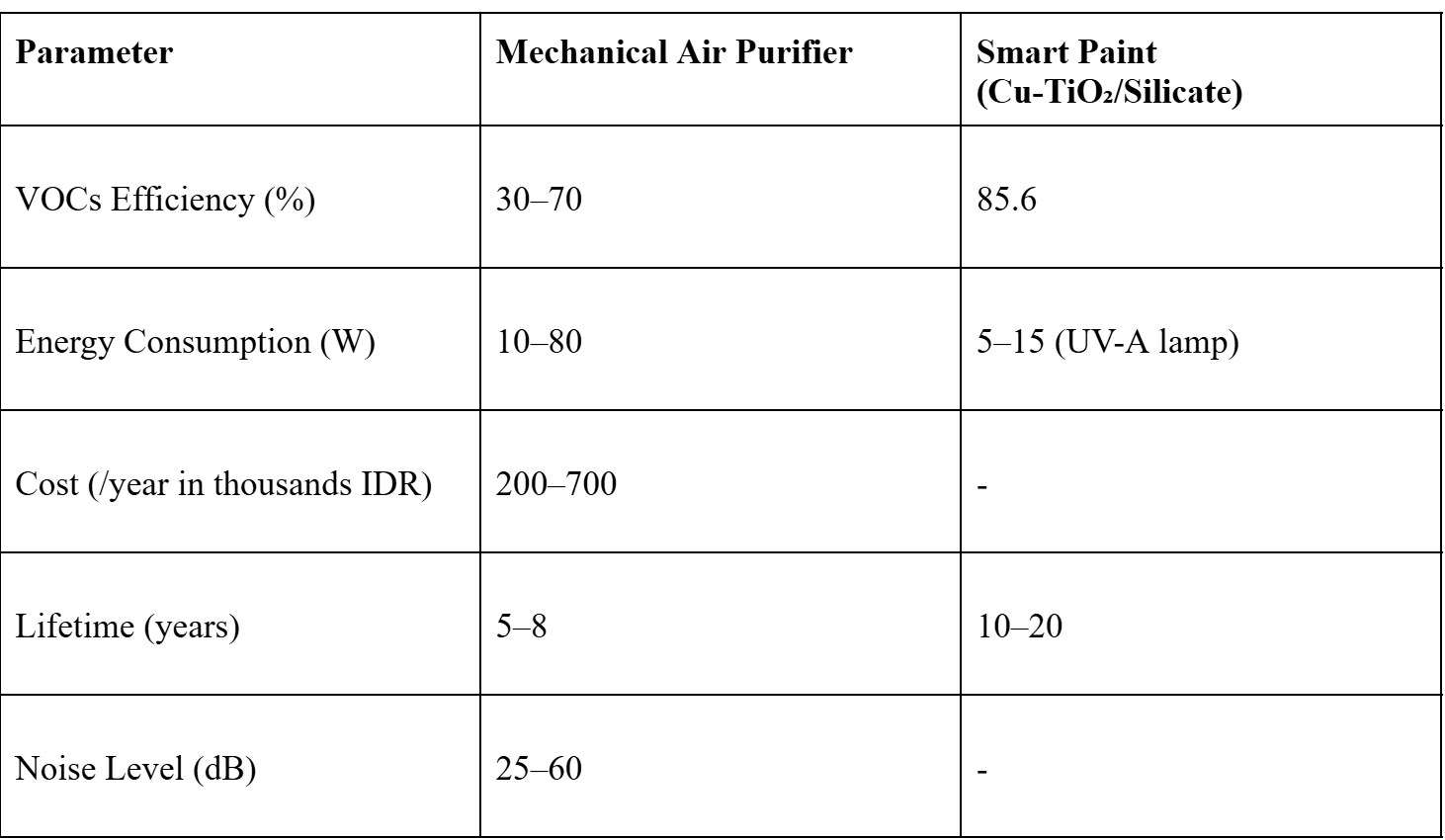 Comparison of air purification technology
Double Layer Innovation
Every powerful technological innovation must be accompanied by critical questions about its safety. This led me to ask a more critical question, not just “Does it work?”, but “Is it safe, and what could go wrong?” However, this raises a new concern: could copper particles, which are heavy metals, be released from the paint and become a new toxin?
Baca juga : Atasi Penurunan Muka Tanah, Tata Kelola Air Di Jakarta Perlu Dibenahi
To address this challenge, a second layer of innovation was applied: silicate encapsulation. Imagine each active Cu-TiO₂ particle wrapped in a microscopic, extremely strong “glass cage.” As the paint dries on the wall, the potassium silicate-based binder reacts with carbon dioxide (CO₂) in the air, forming a rigid, porous, and chemically inert silicate network (Si-O-Si). This process, known as “silicification,” permanently locks the catalyst particles in place, like insects trapped in resin (Conner & Hoeffner, 1998). This encapsulation technology is not new; it has been proven over decades in critical applications such as stabilizing hazardous waste and locking in toxic heavy metals like lead and mercury to prevent environmental contamination. This two-layered approach, a boosted active catalyst, and an encapsulated safety mechanism transform this research from a mere clever discovery into a model of safety-by-design that is crucial for building public trust and ensuring that scientific progress truly benefits humanity.
Baca juga : 50 Ribu TKI Bisa Diisolasi di Jakarta, Batam dan Bali
A Phased Approach to Validation and Deployment
A Roadmap for Multi-Sector Implementation and Impact to bring this brilliant idea from the laboratory has been designed. The plan is divided into three measurable phases:
Phase 1: Laboratory Validation (6 months), focusing on refining the paint formulation and strict quality control protocols.
Phase 2: Pilot Implementation (12 months), involving the application of the paint in 50 apartments in South Jakarta to monitor air quality in real-time and evaluate the durability of the material.
Phase 3: Large-Scale Implementation (24 months), targeting 5,000 apartments, supported by contractor training and the establishment of a reliable supply chain.
Baca juga : Sore Ini, Rapid Test Corona Dimulai di Jakarta Selatan
Addressing the Regulatory Vacuum
The Indonesian National Standard (SNI) 03-6572-2001, which governs the design of ventilation systems in buildings, is outdated (Badan Standardisasi Nasional, 2001). This standard completely fails to regulate chemical emissions from building materials. Prof. Tjandra Yoga Aditama, Chairman of the Honorary Council of the Indonesian Society of Respirology (PDPI), provides an important perspective on this. "In general, for both air pollution and other health issues, every country does not have to follow the WHO 100 percent," he explained. This statement underscores the importance for Indonesia to proactively establish strong and locally relevant national standards, such as revising the existing SNI. This lack of regulation creates a market failure: property developers have neither regulatory nor financial incentives to choose low-VOC building materials—which may be slightly more expensive—over cheaper but toxic alternatives. As a result, an innovation that could save lives and billions of rupiah remains a niche product.
The Multi-Sectoral Dividend
Economically, this technology is very promising, with an estimated return on investment (ROI) of only 3-5 years, through savings in energy and healthcare costs. Replacing mechanical air purifiers in 500,000 apartments in South Jakarta is projected to save 15 to 50 megawatts (MW) of electricity—equivalent to removing a small-scale power plant from the grid—and reduce CO₂ emissions by 12,000 to 40,000 tons per year.
On the health side, the impact is even more dramatic. Based on epidemiological models, reducing formaldehyde concentrations from current average levels to safe target levels could prevent approximately 5,200 cases of childhood asthma each year in Jakarta (Haman, T., et al., 2020). The resulting healthcare cost savings from this reduction in respiratory diseases are estimated to reach IDR 156 billion per year. This benefit directly supports SDG 3 on Good Health and Well-being (United Nations, 2015). By creating a healthier built environment, this technology also becomes a pillar for achieving SDG 11 on Sustainable Cities and Communities.
The convergence of benefits across multiple sectors, health, energy, environment, and economy, makes this technology a highly attractive strategic investment. It is this synergy that makes it highly relevant to the national long-term development, such as the Golden Indonesia 2045 Vision.

Tiara Desrana Putri
Tiara Desrana Putri - Universitas Indonesia
Tiara Desrana Putri - Universitas Indonesia
Update berita dan artikel RM.ID menarik lainnya di Google News
Dapatkan juga update berita pilihan dan breaking news setiap hari dari RM.id. Mari bergabung di Grup Telegram "Rakyat Merdeka News Update", caranya klik link https://t.me/officialrakyatmerdeka kemudian join. Anda harus install aplikasi Telegram terlebih dulu di ponsel.
Tags :
Berita Lainnya